
National Archives Turns to Master Papermaker to Safeguard the Declaration of Independence
As the United States marks the 250th anniversary of the signing of the Declaration of Independence in 2026, millions of Americans and international visitors, including Fulbrighters, travel to the National Archives in Washington, D.C. to view the original document, along with the Constitution and the United States Bill of Rights.
Known collectively as the Charters of Freedom, these fragile parchments have endured centuries of travel, handling, and exposure. In 1999, the National Archives began a major effort to replace the aging encasements that had held them since their installation half a century earlier. The project required collaboration across disciplines. Conservators restored the parchments, while scientists from the National Institute of Standards and Technology and NASA helped develop a state-of-the-art titanium display cases. Inside the sealed cases, the documents also required a specialized base layer that could safely support the centuries-old parchment.
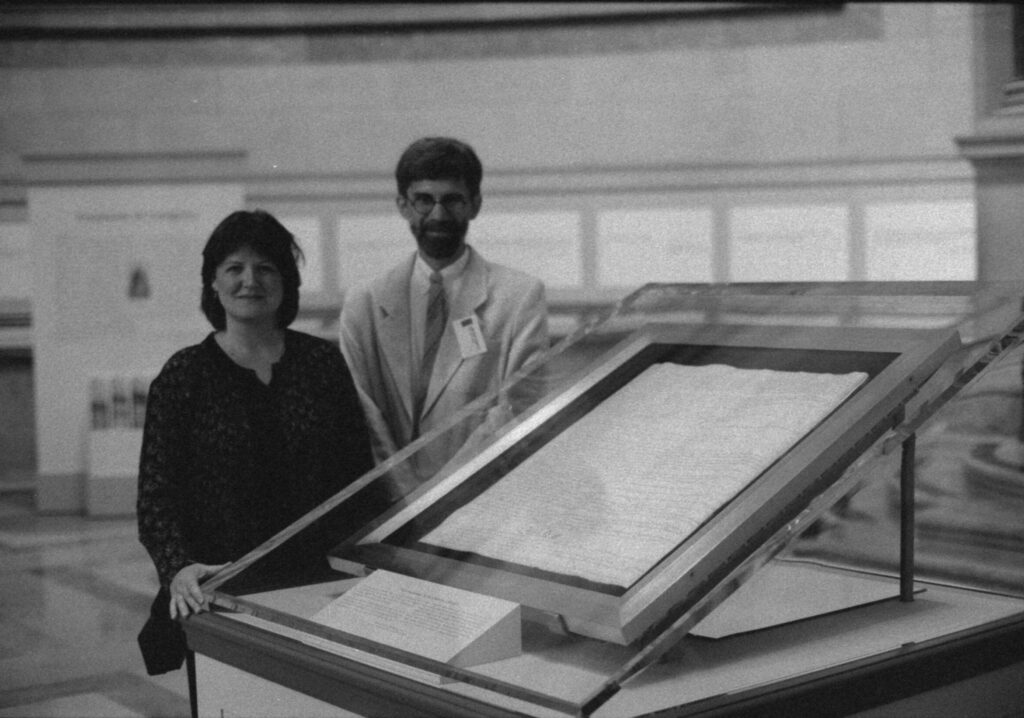
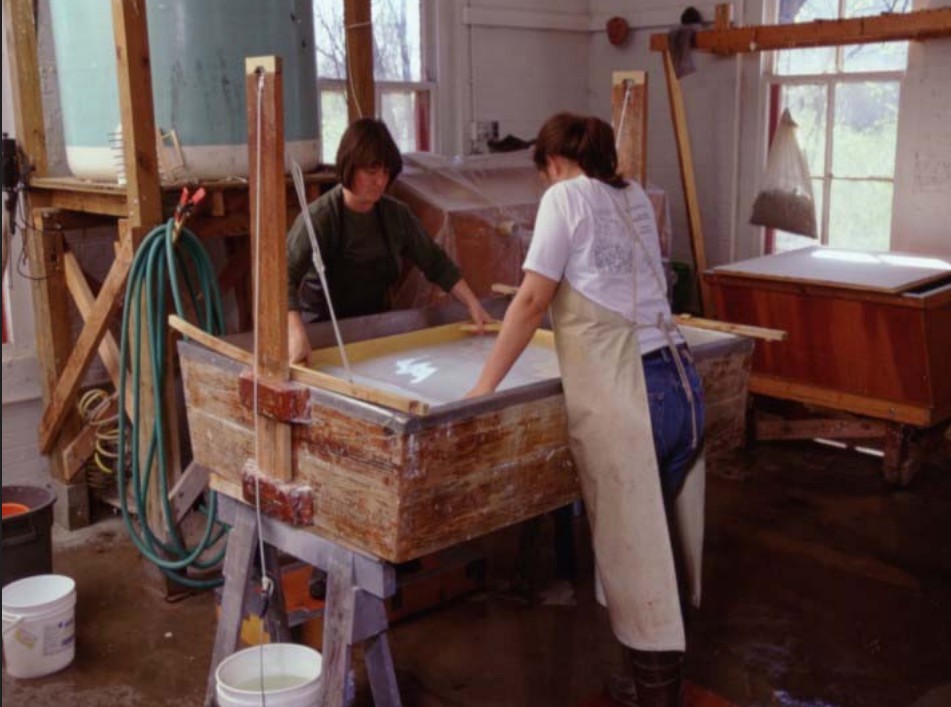
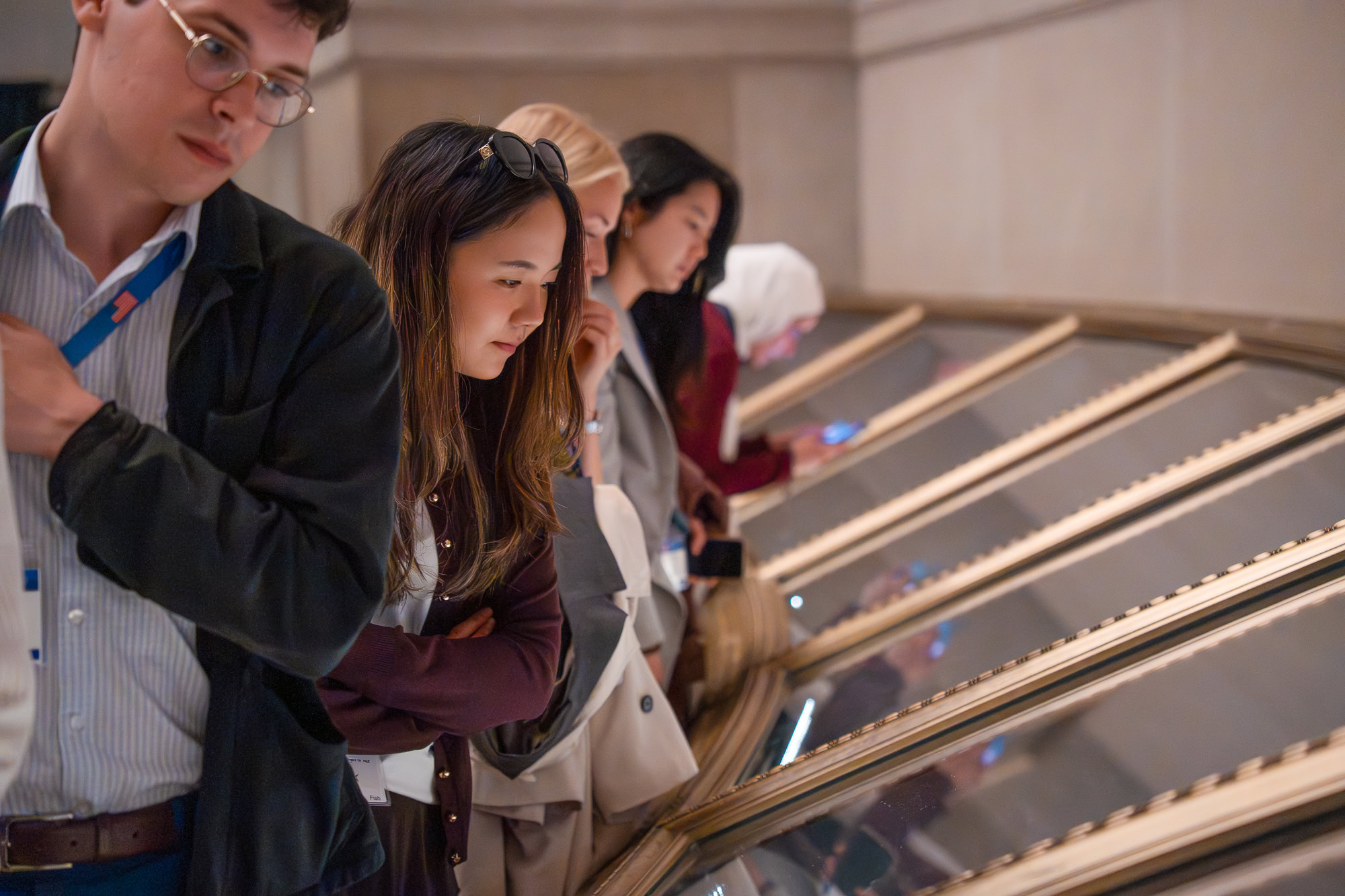
Tim Barrett and Lynn Amlie with the first completed encasement, Circa 2000, National Archives Rotunda, Washington, D.C (left photo, courtesy of National Archives photo 64-CRP-27-1396-ARCH045); Lynn Amlie and Sara Langworthy Shaking Mould As Excess Water Drains, University of Iowa Center for the Book Research and Production Paper Facility, Iowa City, Iowa, Circa 1999 (center photo, courtesy of Tim Barrett Collection, Charters of Freedom Papermaking, University of Iowa); Fulbright Students visit the National Archives to view the Charters of Freedom during a Freedom 250 Seminar in April 2026 (right photo).
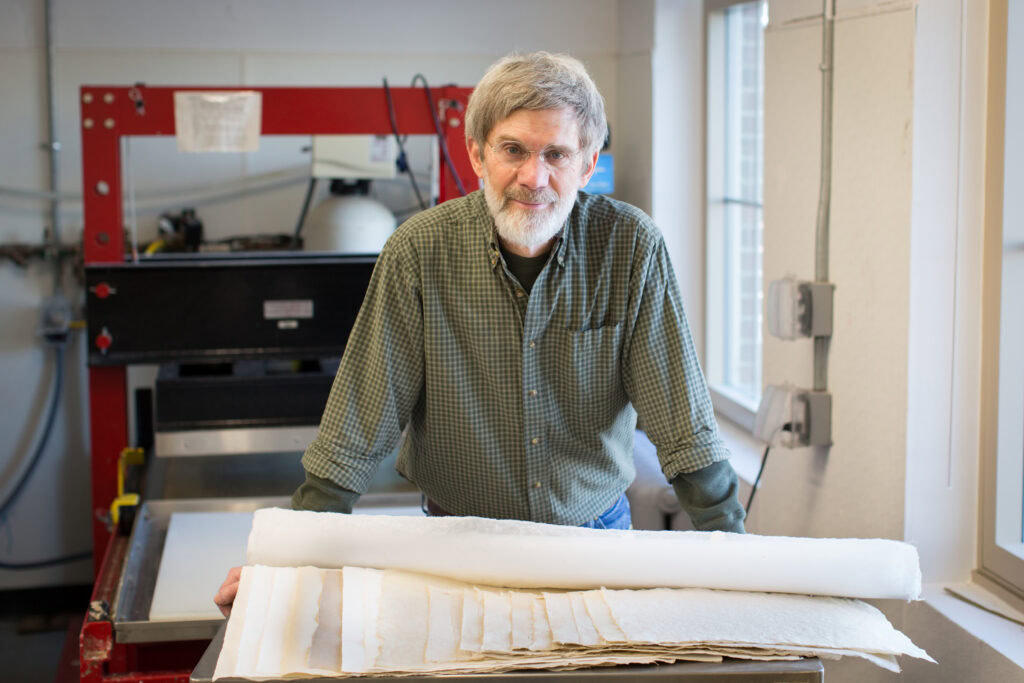
The National Archives turned to master papermaker Timothy Barrett to ensure the Charters of Freedom remain stable and visible for future generations. Barrett and his team designed and produced a layer of hand-made archival paper, drawing on specialized skills he first learned through a Fulbright award to Japan.
Barrett’s path to this role began during his childhood in Kalamazoo, Michigan, once known as “The Paper City.” The city’s paper industry flourished throughout the first half of the twentieth century. His father, a professor of English and American literature, introduced him to pre-industrial bookmaking. As a teenager, Barrett carried a piece of Japanese paper with him because he admired its “warm natural texture.” At the time, he said, “I never dreamed I would one day be able to go to Japan and learn directly from the people who made that type of paper.”
That opportunity came in 1975, when Barrett received a Fulbright award to study traditional papermaking in Japan, working with experienced craftspeople to learn techniques that had been refined over centuries. The experience launched his career, shaping both his technical skills and his perspective.
“You go to learn about this other culture,” he said, “but the most valuable things you learn are about your own culture and yourself.” He developed a method of studying finished paper to understand how materials and process influence the final result.
In 1986, Barrett founded the papermaking facilities at the University of Iowa, where he trained students in both Japanese and European techniques. He joined the university at its new Center for the Book—an innovative, interdisciplinary research and arts unit which the university launched to combine training in bookmaking techniques with scholarly research. Guiding students in techniques such as letterpress printing, papermaking, and bookbinding, he served as the director of the center from 1996 until 2002, and again from 2012 until he retired in 2020.
His work at the University of Iowa focused on producing conservation-quality paper and understanding the long-term behavior of materials—expertise that proved essential when he was approached by the National Archives to help preserve the nation’s founding documents.
“It was a great honor that came with a lot of responsibility,” he recalled. Working with a team of graduate students, Barrett designed a custom archival paper. Using American-grown, textile-quality cotton, they followed a traditional process: cooking the fibers in lime, washing them thoroughly, beating them into pulp, and forming sheets by hand. Each sheet was carefully pressed and dried, in a process that took several days.
The finished paper serves three purposes for the archival displays: it provides a light background that improves the visibility of the faded text, creates a soft cushion between the parchment and the perforated sheet metal support beneath it, and helps stabilize humidity within the sealed encasement.
Once the new encasements were completed, the Charters returned to public display in the rotunda of the National Archives Rotunda in the early 2000s. Barrett has visited the site twice since the project’s completion. He reflects, “It is of course quite rewarding and moving to see the paper there, underneath those very important documents.”
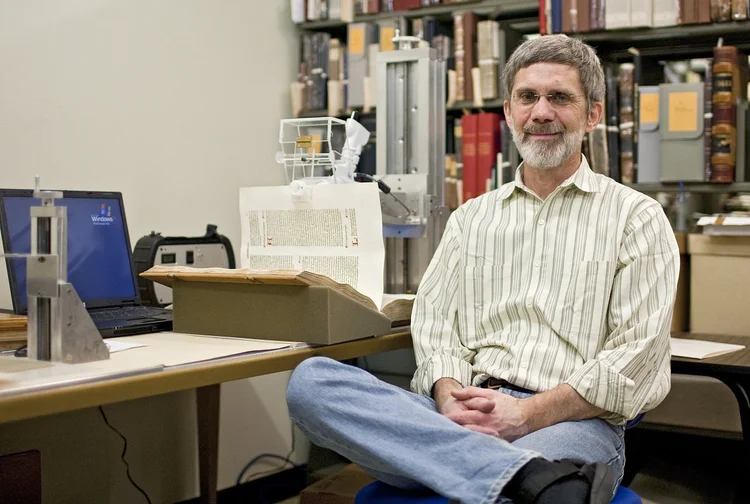
In 2009, Barrett was awarded the prestigious MacArthur Fellowship for his papermaking. The award helped him expand his teaching and research and encouraged the launch of a master of fine arts program at the University of Iowa through the Center for the Book. There, he has passed on his commitment to the study of the book arts and the role of paper and books in “the development and transmission of human culture.” In 2013, he directed and narrated a film on Chancery Papermaking, demonstrating the traditional European method used for centuries prior to the invention of papermaking machinery.
Barrett was one of several directors who anchored the university’s Center for the Book for more than 30 years and expanded its global reach. In 2002, he was also invited to serve on the advisory board for a separate statewide literacy initiative, called “Iowa Center for the Book”, which is housed at the Ames Public Library and is part of a national network of centers affiliated with the Library of Congress.
When he retired from the University of Iowa, his colleagues honored him with a short documentary, Tim Barrett: The Story of a Papermaker, telling the story of his role at the university and his work with the National Archives.
Barrett’s contribution to the Charters of Freedom display reflects the long-term impact of his Fulbright experience as the nation celebrates the 250th anniversary of the signing of the Declaration of Independence. The skills he developed in Japan serve a practical purpose and an inspiring one, ensuring the foundational documents at the center of American history, freedom, and democracy remain on view to inspire current and future generations.